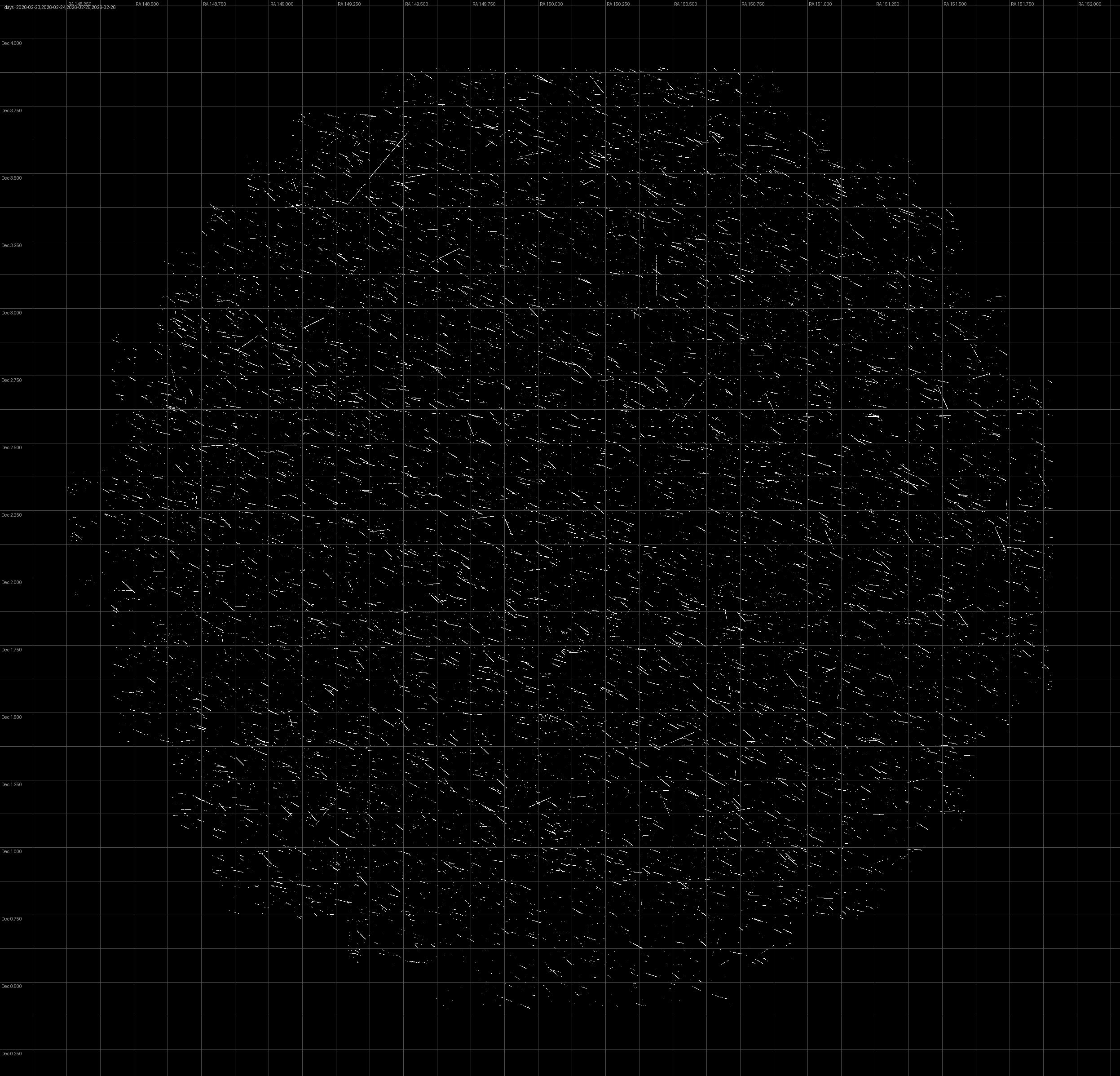
Quick update from the “binary bitmap of surviving alerts” side.
I pushed the analysis quite a bit further from just pics. All points below are already after:
- the ML moving-object-like filter
- local
astcheck / MPChecker-like singleton matching at 30 arcsec
So this is no longer the raw alert layer; it is already a post-known-object-veto candidate layer.
I tested two intraday branches:
- 4-point minimum tracklets
- 3-point minimum tracklets
and then ran:
- same-day iterative merging
- a curvature-aware multi-night brute-force linker
At the moment these are still track / orbit hypotheses, not final orbit solutions yet.
Main field around the original bitmap region (RA 148–152, Dec 0–4)
This is where the strongest effect appears.
-
3-point branch: 2157 tracks = 1391 multi-night + 766 doubles
-
4-point branch: 1933 tracks = 1302 multi-night + 631 doubles
If I look only at the longer arcs (4+ nights):
-
3-point branch: 894 tracks backed by 314,777 points
-
4-point branch: 839 tracks backed by 307,596 points
An interesting detail is that the 3-point branch does not merely add more short chains. In this region it seems to push some solutions upward in arc length: compared to the 4-point branch, it has fewer 5-night tracks but more 6-, 7-, and 8±night tracks. Using overlap tests, I found 68 cases where a 4-point 5-night track is almost fully contained in a 3-point 6±night track.
Second dense region (RA 184–189, Dec 5–10)
Here the gain is much smaller, but still real.
-
3-point branch: 1305 tracks = 787 multi-night + 518 doubles
-
4-point branch: 1295 tracks = 768 multi-night + 527 doubles
For 4+ nights:
-
3-point branch: 623 tracks backed by 122,092 points
-
4-point branch: 598 tracks backed by 120,175 points
In this region the 3-point branch gives a modest, fairly uniform increase across 4–7 night tracks, with almost unchanged fit quality. I also see some upward extension here, but much less strongly than in the main field: only 8 high-overlap cases of the same 5-night → 6+ pattern.
Third, much weaker region (RA 56–66, Dec -51 to -46)
This one is mostly a negative result:
- both branches currently give 2 tracks total
- the 3-point branch greatly increased the input tracklet pool there, but that did not translate into more multi-night tracks
Current pipeline snapshot
Across the three test regions:
-
3-point branch: 3464 tracks = 2179 multi-night + 1285 doubles
-
4-point branch: 3230 tracks = 2071 multi-night + 1159 doubles
If I restrict to the two strong regions and only look at 4+ night tracks, I get:
-
3-point branch: 1517 long-track hypotheses backed by 436,869 points
-
4-point branch: 1437 long-track hypotheses backed by 427,771 points
So relative to the original bitmap: yes, a large fraction of those short linear features can be turned into candidate intraday tracklets and then into multi-night track hypotheses. The 3-point branch appears useful mainly because in at least one dense field it sometimes extends arcs rather than only inflating the candidate count.
Next step on my side is orbit fitting. I will likely keep both branches: the 4-point one is a bit cleaner, while the 3-point one sometimes produces longer arcs.
I can share a cleaned-up technical note and code once I package it better.