It’s an interesting note that for some reason I don’t understand, the debris object @Zhuoxiao found is not appearing in the SatChecker query results. I will follow up with the SatChecker developer about that; we (at IAU CPS SatHub, where this tool is developed) have had issues with debris not always appearing in results when it ought to. The glint detection algorithm we currently run (in the LSST Science Pipelines) requires 5 or more glints in a line in a single detector, so we missed this one.
4 Likes
Hi @mrawls, I was wondering why my satchecker query wasn’t catching the debris object, reassuring to know this is a known issue/being looked at.
1 Like
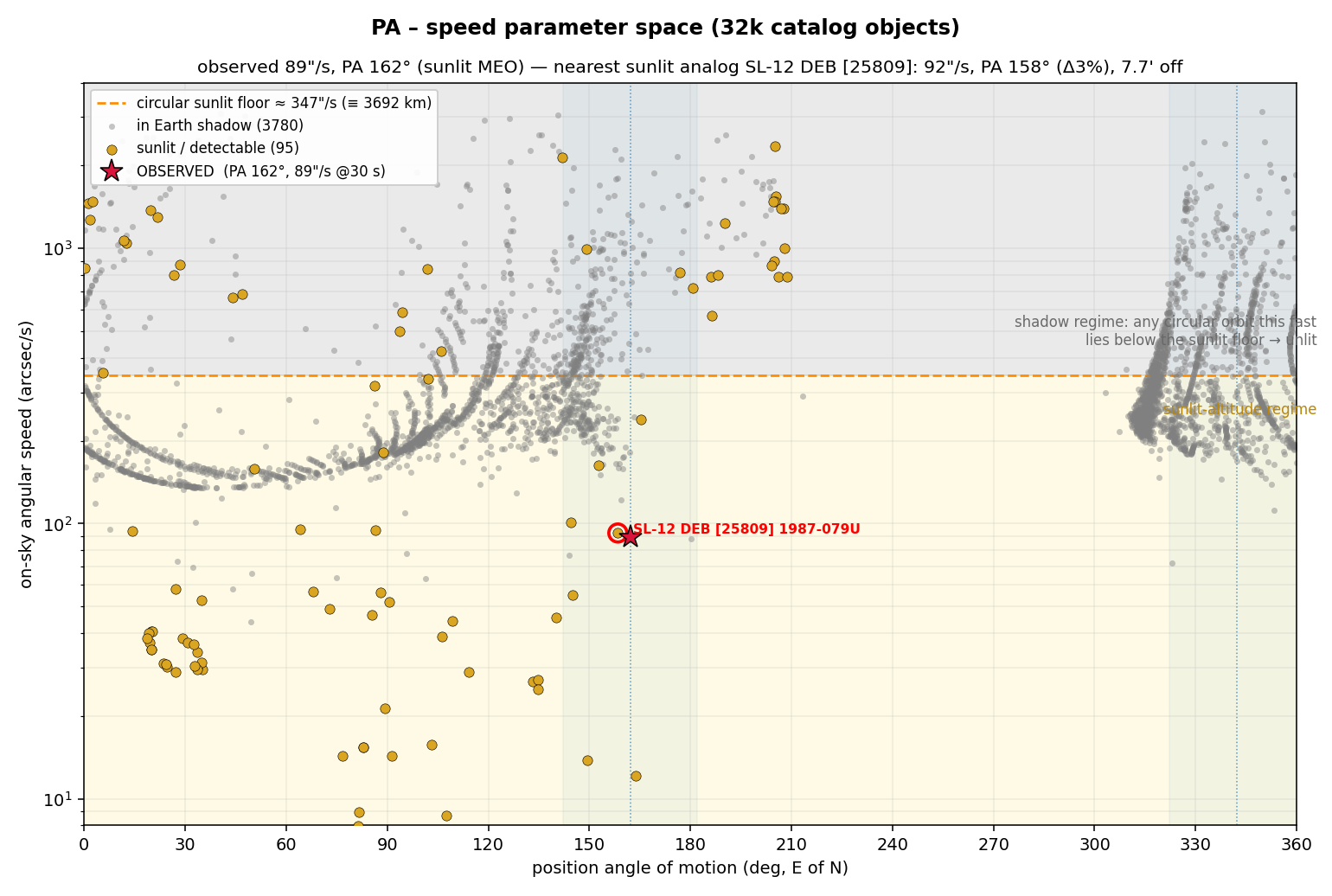
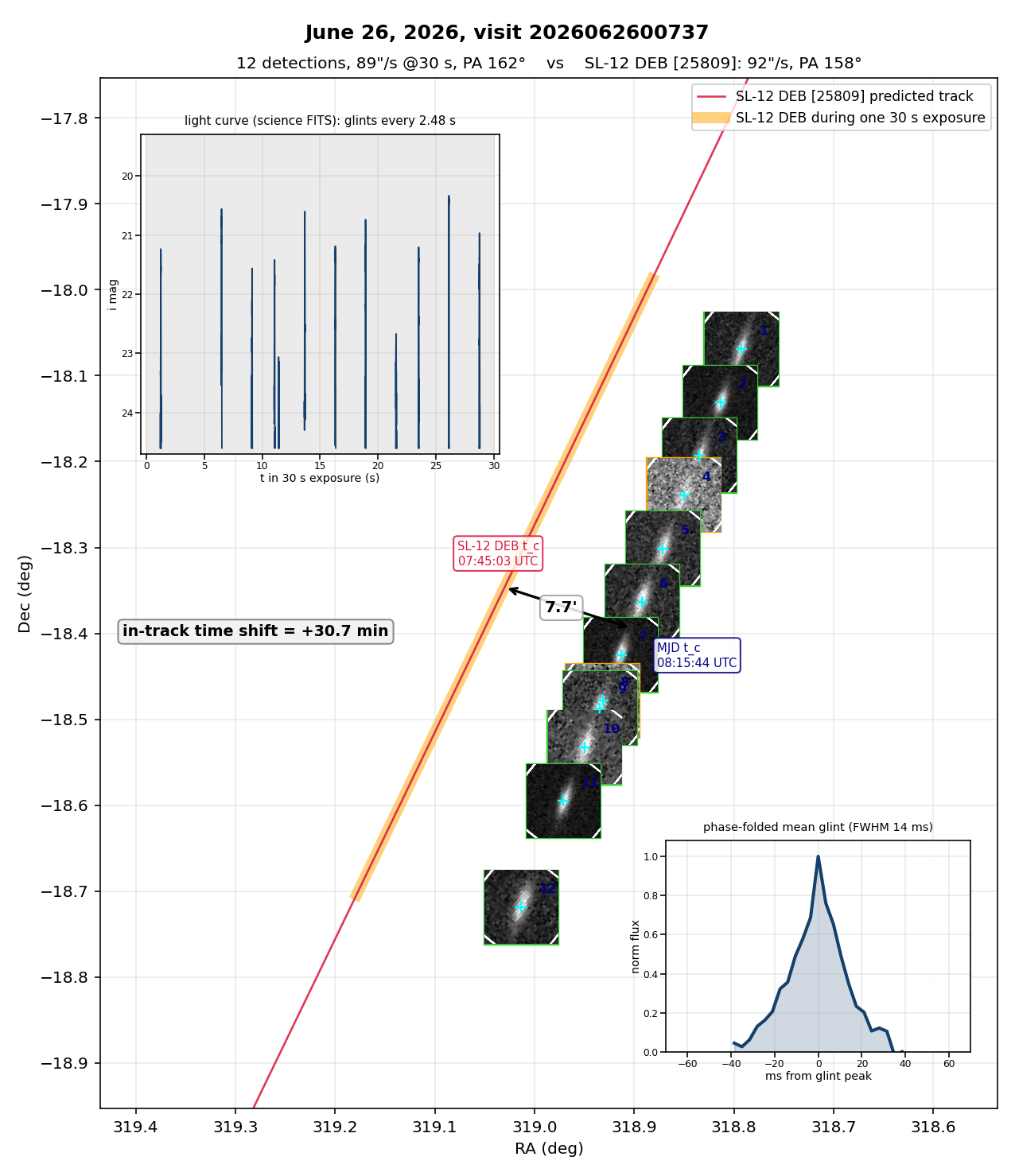
sorry about my previous matching statement, I should emphasize the match is from dynamical phase space, i.e. motion speed (detection 89 arcsec/s v.s debris 92 arcsec/s) and position angle (detection 162 deg v.s debris 158 deg). And the predicted FOV passing has 30min time lag, and 7 arcmin cross track offset. I guess the timeshift is the main reason of your uncatching results.
So I would say, this detection could be an centimeter sized debris (per glint peak magnitude +20~21) shared similar orbit to debris[25809], with 30min phase lag.
Here are two analysis plots to support the idea here.
4 Likes
Possible continuation candidate.
dia_source_id det RA deg Dec deg trail_len trail_angle
170591526750519606 53 317.597304197 -14.473522461 4.24209 -17.2433
170591526750519634 53 317.582062312 -14.426915730 3.23939 -17.1915
170591526754189662 60 317.561690113 -14.364535436 2.68233 -14.3748
170591526774636587 99 317.520791806 -14.239185347 2.93653 -17.3308
170591526775160985 100 317.464680766 -14.067000406 2.64396 -17.3159
170591526775161020 100 317.444156176 -14.004057689 3.58147 -17.2074
170591526775685343 101 317.388146482 -13.831930266 3.72279 -17.1906
170591526775685393 101 317.367831610 -13.769386660 2.57931 -19.0177
170591526779355489 108 317.332207539 -13.659810476 4.08045 -18.8022
170591526780928024 111 317.291463925 -13.534215653 3.79628 -16.9955
170591526781452357 112 317.250619656 -13.408384610 3.71041 -15.6533
170591526781452378 112 317.235503161 -13.361777156 3.51820 -15.9039
170591526781452418 112 317.215228186 -13.299200030 2.83244 -14.9122
170591526781976806 113 317.174573334 -13.173465569 2.51045 -15.8009
170591526781976884 113 317.139074470 -13.063655945 3.13380 -19.7838
dia_source_id det RA deg Dec deg trail_len trail_angle
170591527032062310 78 319.013308051 -18.718804474 2.88491 -19.2217
170591527053033516 118 318.971129819 -18.595060135 2.70202 -18.4659
170591527053033572 118 318.949983144 -18.532821803 3.02049 -15.9433
170591527053033605 118 318.934327839 -18.486895066 3.41755 -19.3728
170591527053033643 118 318.913391677 -18.425268762 2.80940 -16.8657
170591527053557997 119 318.892249956 -18.363129468 3.51493 -18.3858
170591527053558053 119 318.871309117 -18.301360975 3.14460 -17.7760
170591527053558114 119 318.850170998 -18.239119453 4.32057 -18.6338
170591527053558166 119 318.834596605 -18.193101825 3.12075 -17.7318
170591527057228205 126 318.813683661 -18.131424128 2.49933 -18.4545
170591527057228257 126 318.792619830 -18.069207300 3.75666 -17.5341
2 Likes
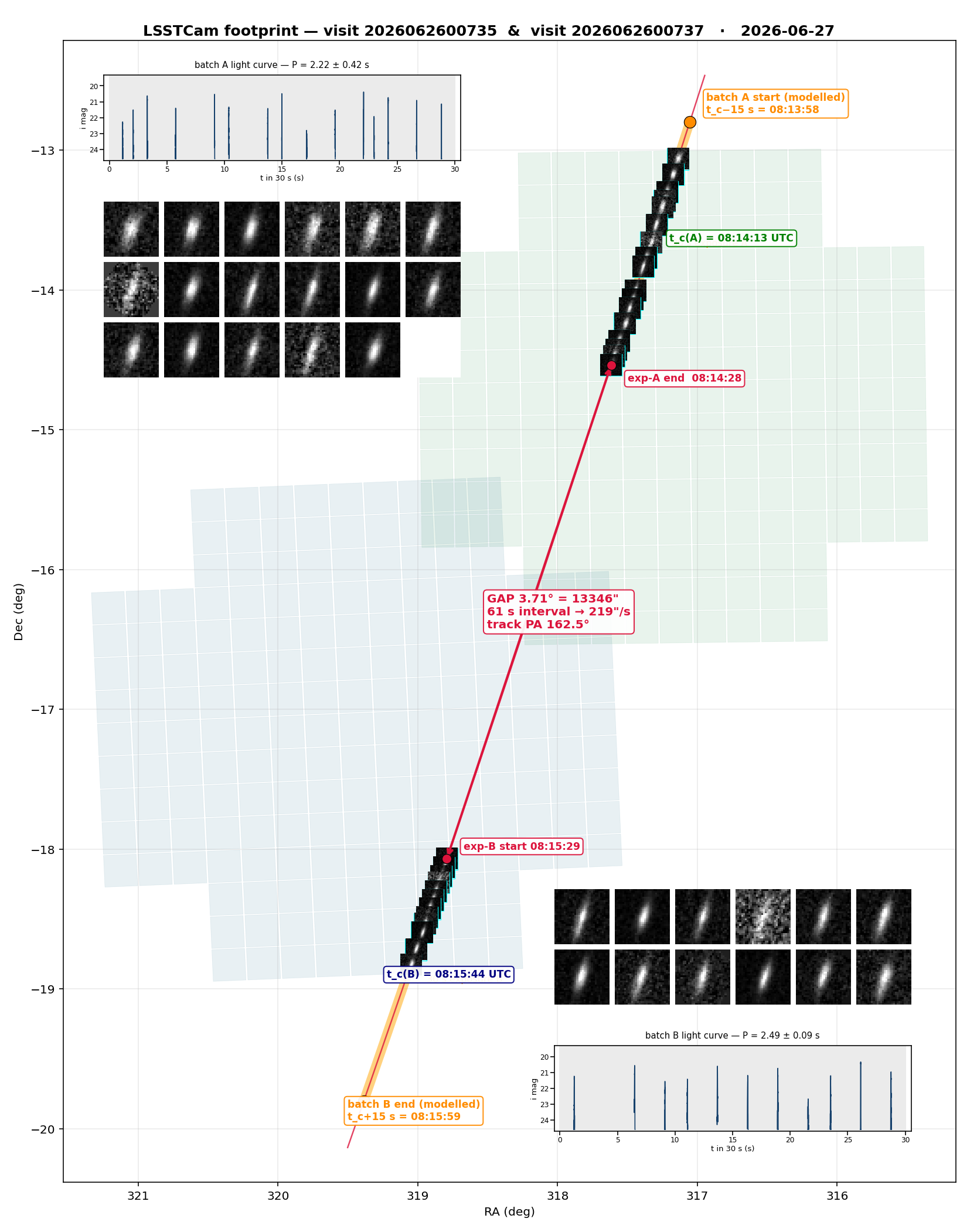
Based on those new potential continuation, I tried to align them up. It seems batch A and B are both part of longer trails, which are cutoff by footprint and 30s exposure cadence. If we still treat this as a single object, across two footprint, the motion can be derived from exposure gap,
~219 arcsec/s, with similar PA 162.5 deg.
At this speed, my catalog matching failed. But it still lands up a realm of centimeter size space debris at thousands of km altitude orbit.
3 Likes
