Potential Interstellar Visitor Found in April-May 2026 LSST Data
Identified by linking unlinked LSST diaSources from the public alert stream.
Submitted to the Minor Planet Center on 2026-06-09; posting here for visibility
and to invite confirmation and image-level follow-up.
Hello all! I have some potentially exciting news to report, but please verify my data for yourself and offer any alternative hypotheses or caveats I should be aware of in case I’m missing something.
Summary
I’ve been using HelioLinC/Heliolinx with custom hypothesis grids to search for Interstellar
Visitors in Fink and Lasair Data, and found what appears to be a pretty strong candidate for
a new Interstellar Visitor (4I?). It has a strongly-hyperbolic trajectory, whose orbit has been
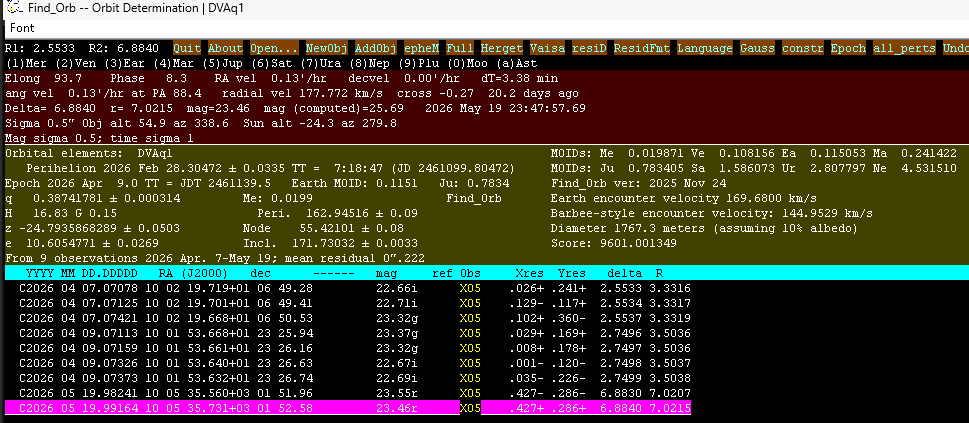
independently verified with Find_Orb. Both converge on the same retrograde hyperbolic
solution. The object is not present in the Rubin SSP linked output, or in the MPC database. If confirmed, it would also be the fastest known object to ever have been detected moving through our Solar System (148 - 170 km/s).
What I’ve tentatively labelled as DVAq1 appears to have entered our Solar System from the direction of Aquarius (bordering on Pisces), crossing the asteroid belt in early February, the orbits of Mars and Earth in mid-February, and whipping around the Sun at perihelion on February 28th, passing at almost exactly Mercury’s distance from the Sun (0.39 AU). It’s been climbing back out ever since, and today it’s expected to be located in the faint constellation of Sextans, just beneath Leo. If the hyperbolic orbit holds up, it’s on a one-way trip back into interstellar space.
Unfortunately, it is too faint now for any ordinary telescope to see, but it’s possible it could still be visible within the next 4-6 weeks if LSST or another high-powered observatory sweeps that part of the sky. It was not visible in February due to Solar Conjunction, and will be hidden again by the Sun at the beginning of August. If its current 43-day arc is not extended with at least one more night of observation, we may never know for sure whether it was a true ISO.
Astrometry Submitted to MPC on June 9, 2026
     DVAq1    C2026 04 07.07078 10 02 19.719+01 06 49.28         22.66i      X05
     DVAq1    C2026 04 07.07125 10 02 19.701+01 06 49.41         22.71i      X05
     DVAq1    C2026 04 07.07421 10 02 19.668+01 06 50.53         23.32g      X05
     DVAq1    C2026 04 09.07113 10 01 53.668+01 23 25.94         23.37g      X05
     DVAq1    C2026 04 09.07159 10 01 53.661+01 23 26.16         23.32g      X05
     DVAq1    C2026 04 09.07326 10 01 53.640+01 23 26.63         22.67i      X05
     DVAq1    C2026 04 09.07373 10 01 53.632+01 23 26.74         22.69i      X05
     DVAq1    C2026 05 19.98241 10 05 35.560+03 01 51.96         23.55r      X05
     DVAq1    C2026 05 19.99164 10 05 35.731+03 01 52.58         23.46r      X05
Orbit (Find_Orb, consistent with heliolinx)
| element | value |
|---|---|
| epoch | 2026 Apr 9.0 TT |
| eccentricity e | 10.6 ± 0.13 |
| perihelion distance q | 0.387 AU |
| inclination i | 171.7° (retrograde) |
| ascending node Ω | 55.4° |
| arg. perihelion ω | 162.9° |
| perihelion time | 2026 Feb 28.3 |
| v∞ | ≈ 148 km/s |
| abs. mag H | ≈ 16.8 (~1.8 km at 10% albedo) |
| arc | 2026 Apr 7 – May 19 (9 detections, 3 nights, 43 d) |
| mean residual | 0.222″ |
Two further, lower-confidence candidates
Curiously, two more objects appear in the same field and epoch with similar retrograde
inclinations (DVAq2 i ≈ 167°, DVAq3 i ≈ 168°, vs DVAq1 i ≈ 172°). However, their
orbits are only weakly constrained by shorter arcs, and their mean residuals much higher (1.24″ and 1.58″). It’s tempting to think they may be related somehow (fragmented pieces of a larger object?), but the best fit of their orbits individually don’t match DVAq1 very well (e ≈ 5 and e ≈ 15), so these are possibly just unrelated observations that got linked together weakly due to statistical artifacts. I include
them for completeness, not as confident detections.
     DVAq2    C2026 04 09.07113 10 06 46.237+02 01 24.28         23.30g      X05
     DVAq2    C2026 04 09.07159 10 06 46.235+02 01 24.52         23.17g      X05
     DVAq2    C2026 04 09.07326 10 06 46.220+02 01 25.10         22.55i      X05
     DVAq2    C2026 04 09.07373 10 06 46.221+02 01 25.30         22.56i      X05
     DVAq2    C2026 04 12.06768 10 06 30.758+02 18 34.77         22.75r      X05
     DVAq2    C2026 04 12.07012 10 06 30.754+02 18 35.51         22.25z      X05
     DVAq2    C2026 04 16.08082 10 06 29.908+02 35 44.51         22.60r      X05
     DVAq2    C2026 04 16.09238 10 06 29.881+02 35 47.77         22.39z      X05
     DVAq2    C2026 04 16.17421 10 06 29.780+02 36 10.61         22.54i      X05

     DVAq3    C2026 04 08.07630 09 58 08.290+02 59 27.96         22.53r      X05
     DVAq3    C2026 04 08.07920 09 58 08.256+02 59 28.86         22.06z      X05
     DVAq3    C2026 04 08.07970 09 58 08.249+02 59 28.93         22.24z      X05
     DVAq3    C2026 04 09.07110 09 57 58.812+03 04 23.02         23.52g      X05
     DVAq3    C2026 04 09.07160 09 57 58.802+03 04 23.12         23.62g      X05
     DVAq3    C2026 04 09.07330 09 57 58.786+03 04 23.63         22.89i      X05
     DVAq3    C2026 04 09.07370 09 57 58.783+03 04 23.77         22.90i      X05
     DVAq3    C2026 04 30.00840 09 58 35.143+03 49 23.41         22.84r      X05
     DVAq3    C2026 04 30.07020 09 58 36.062+03 49 32.20         22.96r      X05
What would help
Confirmation, a designation, and image-level follow-up — in particular a check
for cometary morphology and verification of the point-source astrometry. If anyone
with access to the LSST images (or archival ATLAS/ZTF coverage of the March outbound leg, RA ~152–164°) can take a look, please let us know!
Also, if anyone involved in the LSST commissioning/observing plan could prioritize a visit to RA 10ʰ12ᵐ, Dec +03° (drifting ~0.5°/month eastward) in the coming weeks, or co-add whatever images of it do get taken, it could catch the object again before it fades and slides into Solar Conjunction.
Thank you for reading! And feel free to reach out with any questions or comments.
Domino Valdano, PhD
Independent Researcher
