Given the recent weather issues in Chile, has there been any consideration for the deep Ocean season for EDFS_a and _b, which was planned for the period of August-September, 2026 through March-April, 2027?
1 Like
I think the current plan will be to resume the DDF observations as scheduled. Observations that are more than 2-days past their target observe by date are ignored by the scheduler. The DDF program is limited to be about 7% of the survey time, so we can’t reschedule those missed DDF observations without taking more time out of the main survey and going over budget.
3 Likes
Also, FWIW, EDFS_an and _b are not scheduled for a deep season in Y1 anymore. We are planning on COSMOS in Y1 only, but any other deep seasons were postponed to Y2+.
I remember you’ve been running the deep drilling observation generation yourself – can you check if the script has been updated in our git repo compared to your version?
1 Like
@ljones @yoachim The most recent file that I can find using the link that Peter gave me in the other conversation is from July 23, 2026. I’m guessing from your message that there may be a more recent version.
Ah right I see - I think I’m remembering that he gave you an npz data file not the directions on how to generate that file, which means that he now has to update the references file and tell you the new hash or make a generic link and track which hash it is in some other way.
I’ll leave him to update that then.
Here’s a link to a notebook example for grabbing the latest DDF survey: ddf_schedule/ddf_schedule/DDF_schedule.ipynb at main · lsst/ddf_schedule · GitHub
1 Like
@yoachim The plot for September 3 looks to be like the earlier plot from July. EDFS_a and _b are shown as going into their deep ocean season before COSMOS.
Yes, the EDFS fields are at a different RA than COSMOS, so they start their first full observing season slightly before COSMOS. Both COSMOS and EDFS are set to have their ultra-deep season as soon as they are available for a full season of observing.
Given the current closure due to weather, we may decide to shift update the nominal survey start date and that would shift the DDF schedule to something like:
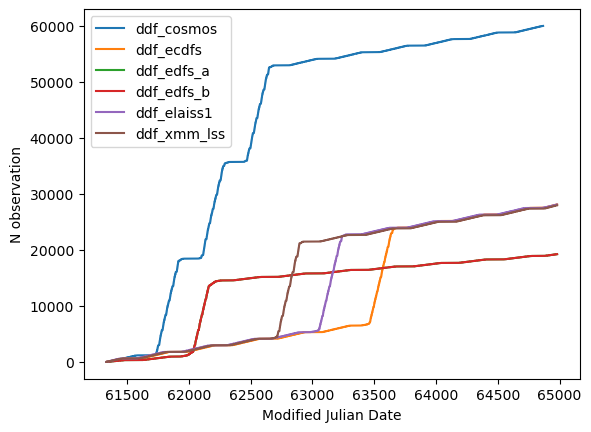
So I think the answer to your original question is, “We hadn’t given it much thought, but the code will bump the EDFS ultra deep season later if we change the survey start date in response to the current storm closure.”
EDIT to add: Updated configuration with EDFS ultra-deep season starting later (MJD ~ 62000) should be deployed at the summit shortly. Updated numpy array is available at: https://s3df.slac.stanford.edu/data/rubin/sim-data/ddf_arrays/ts_ddf_array_3d1ec01.npz
1 Like