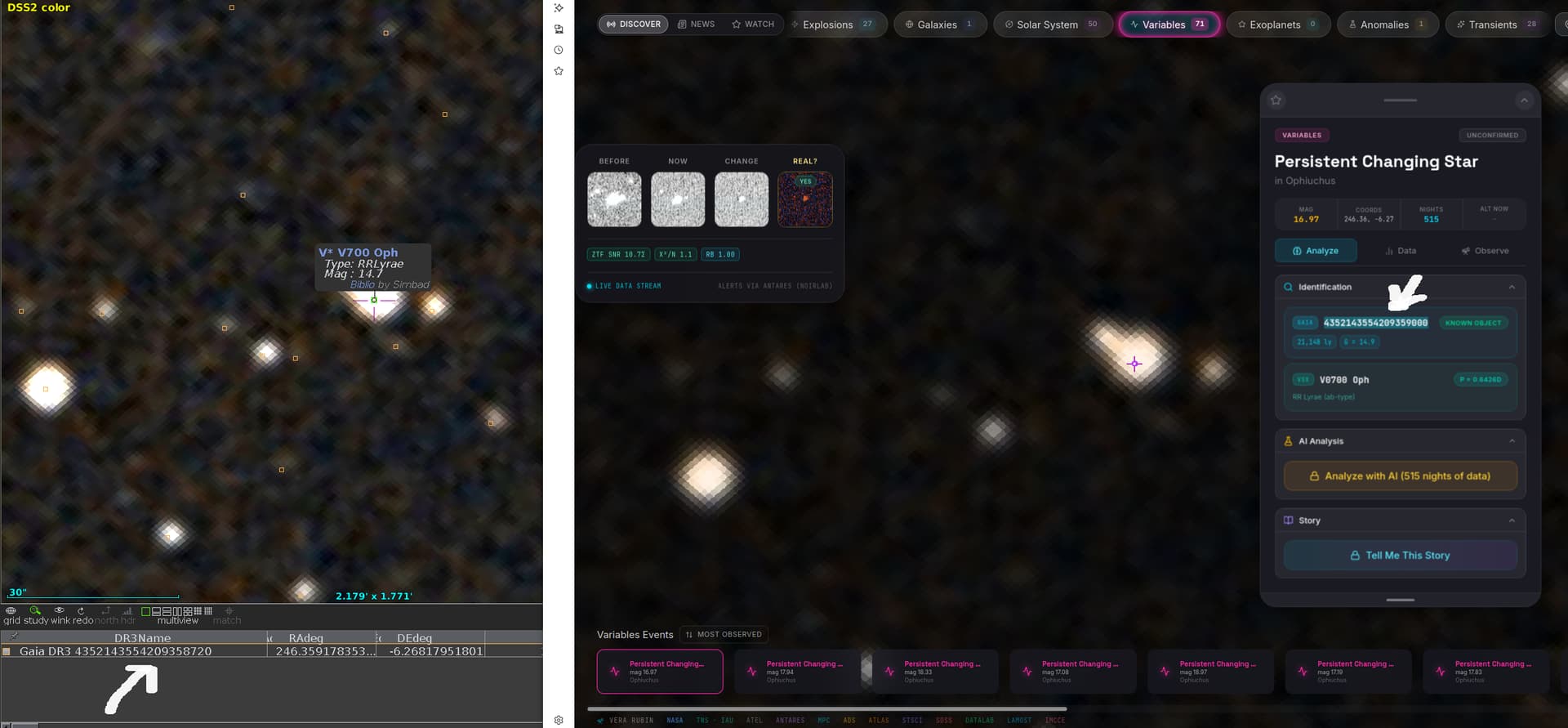
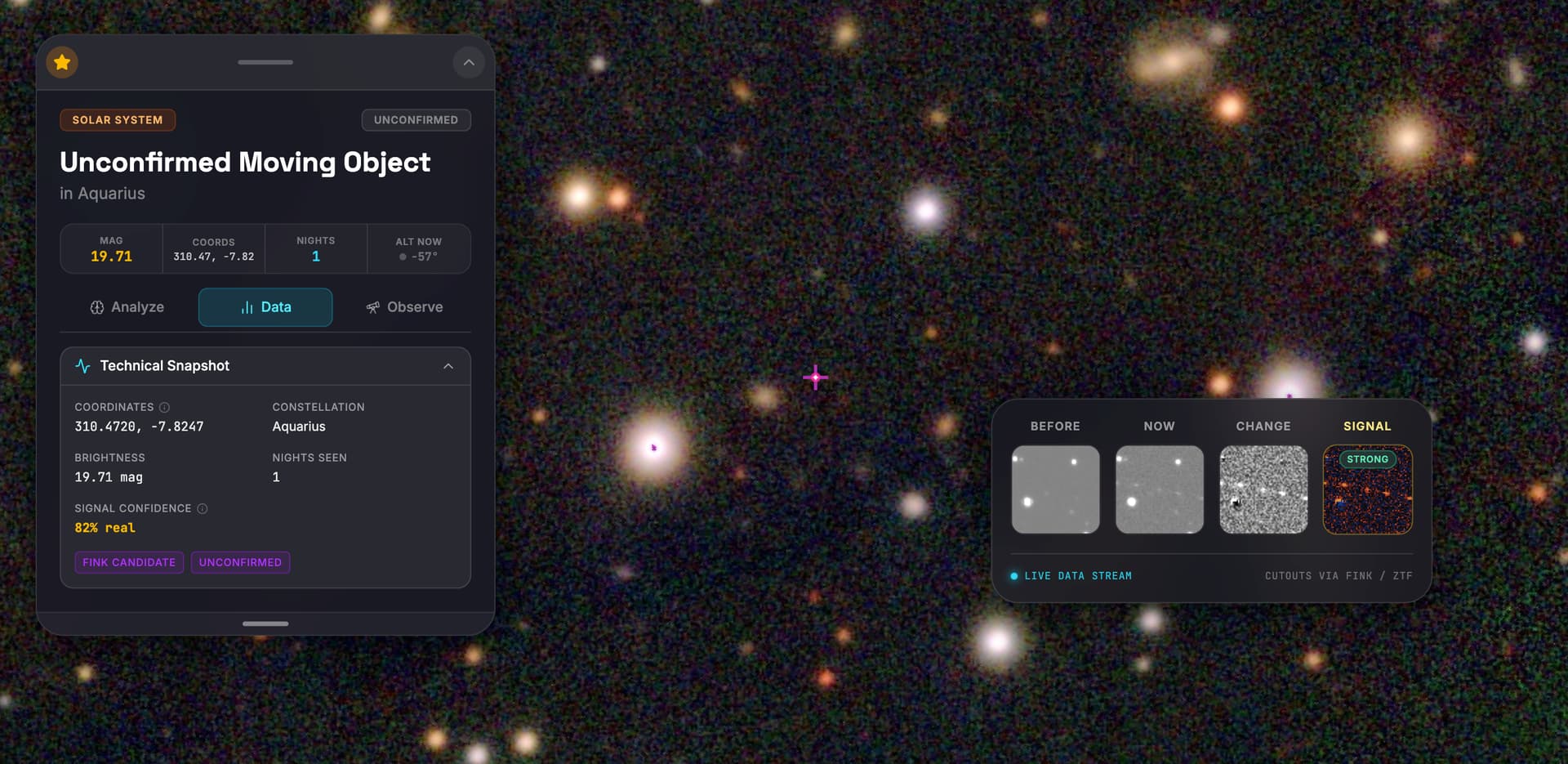
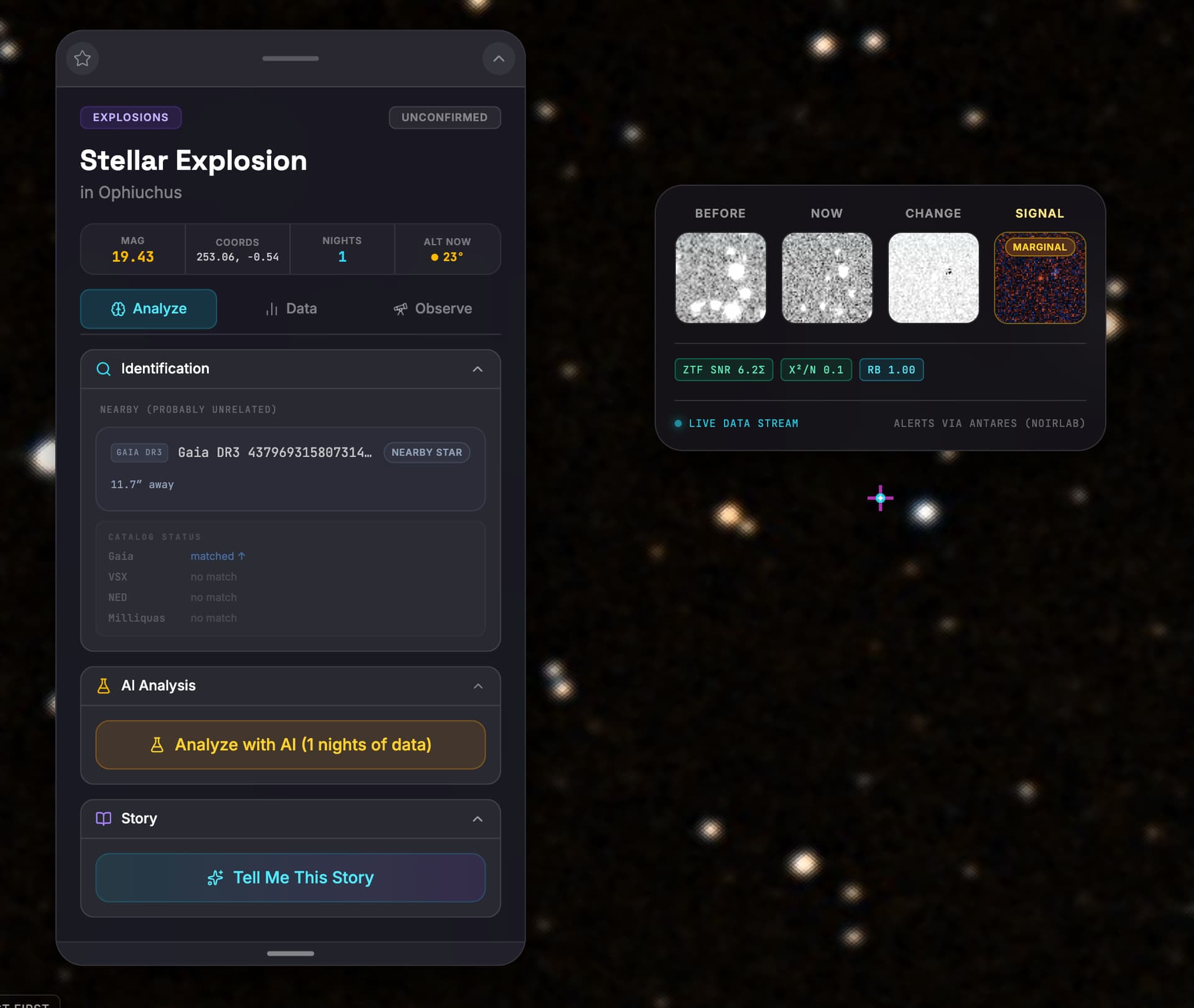
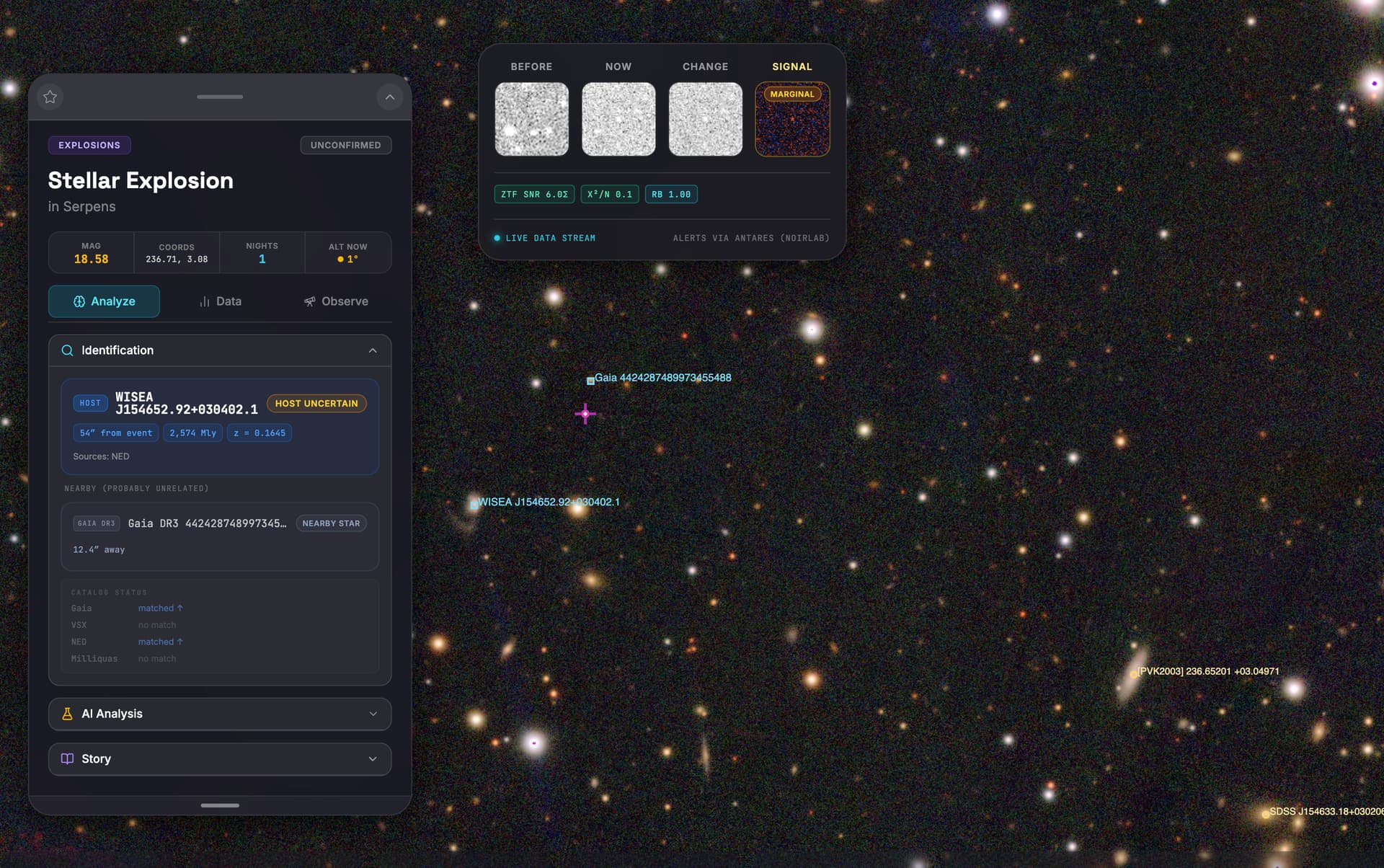
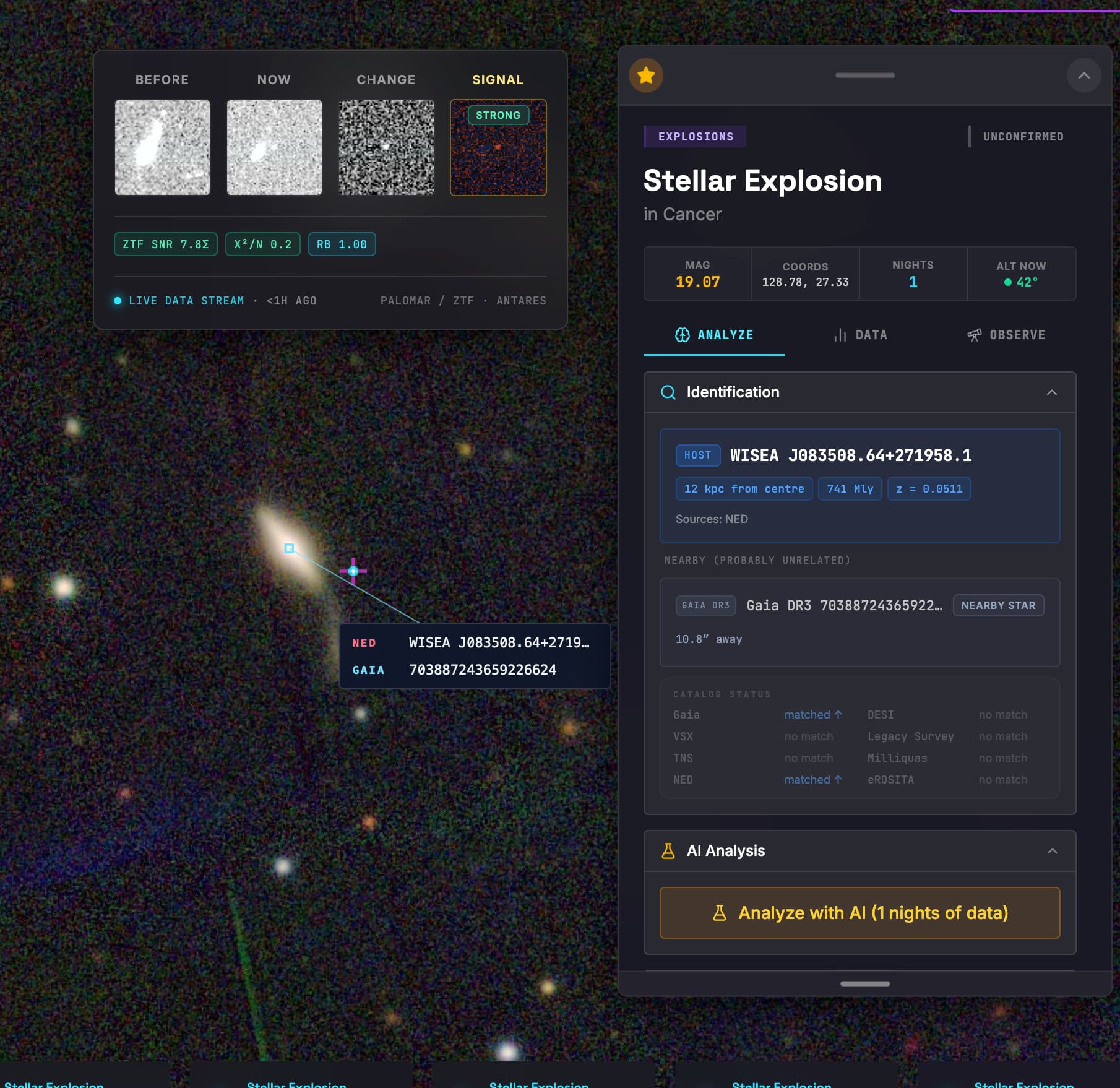
Hi Everyone, I created this web app after watching a Youtube video from Fraser Cain about the public availability of Alerts from the ANTARES broker. I ended up connecting a bunch of different services together after a 1st attempt of integrating the transient alerts into my web app. Some of the features like the telescope control has been simulated but I haven’t tried it out with my telescope yet. I love to get your feedback about it.
Best, Alan
Description:
Vera Rubin Explorer is a citizen-science platform that aggregates real-time transient alerts from the ANTARES broker (fed by the Rubin Observatory’s LSST survey) and lets users discover, classify, and analyze astronomical events across multiple categories — supernovae, near-Earth objects, exoplanet transit candidates, comets, variable stars, and solar system objects via Fink. Each event card is enriched on-the-fly with crossmatches from Gaia, SIMBAD, NED, MAST/JWST, the NASA Exoplanet Archive, MPC, SDSS, and more, giving users multi-wavelength context, light curves, and sky viewer cutouts (Legacy Survey, SkyView, Aladin) in one place. AI-powered features (via Google Gemini) let users run deep analysis of light curves and get narrative explanations of what an object is and why it matters. Users can connect their own telescope mount directly through the browser using the Web Serial API — supporting LX200 (Meade, OnStep, ZWO AM5) and NexStar/SynScan (Celestron, Sky-Watcher) protocols — and slew to any discovered event for real-time follow-up observation from the Observe tab. A built-in watchlist tracks objects of interest, and contribution pathways let users export photometry in BJD-TDB format for NASA’s EXOTIC pipeline or flag new comet candidates for MPC submission. The app also pulls a live news feed from ADS, arXiv, and ATel, keeping users current on the latest astrophysics papers and circulars.