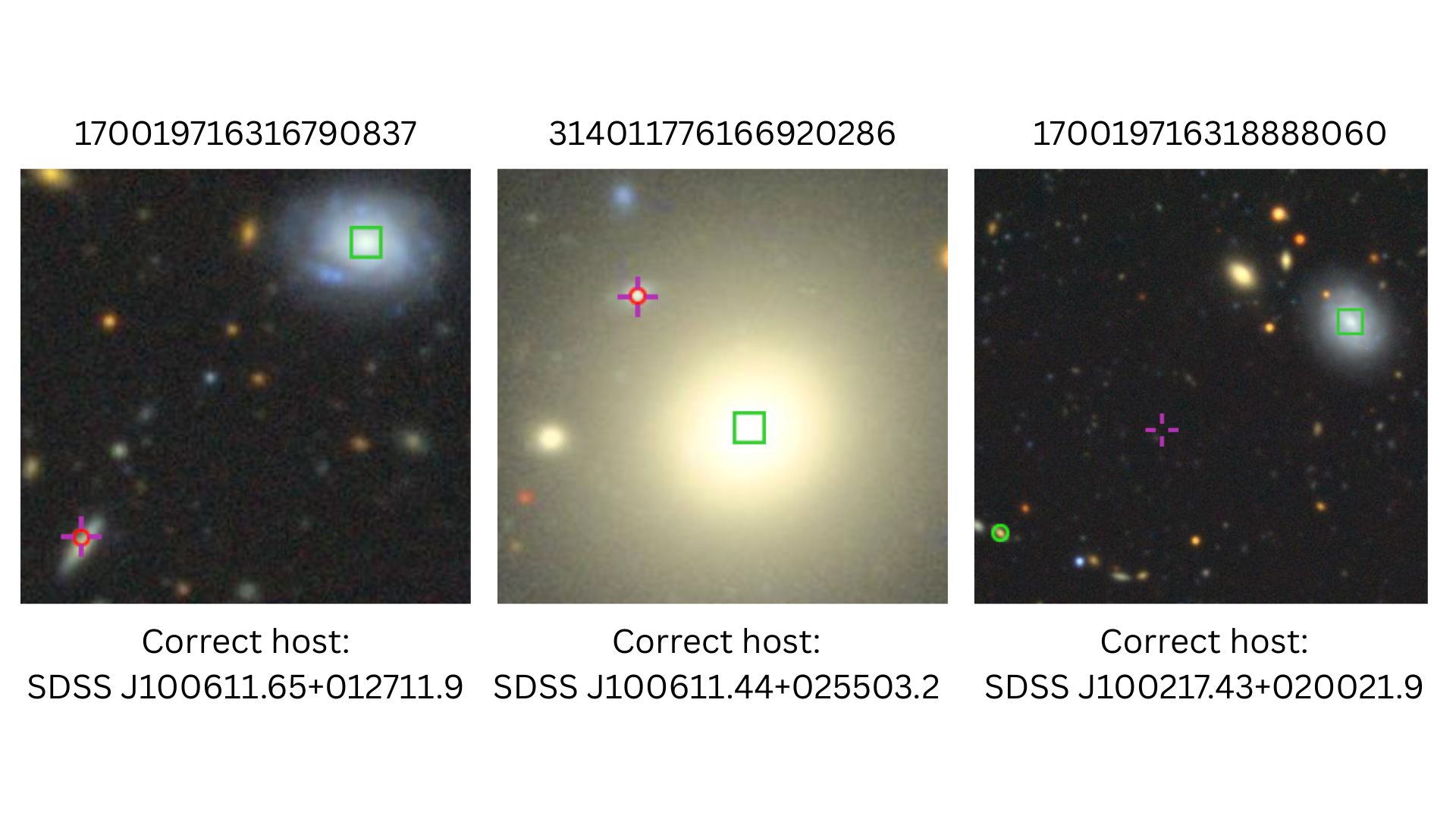
I am currently analysing nuclear transients observed by LSST using Lasair. To filter out objects of interest, I have been using ‘separationArcsec’ from the Sherlock table. I have noticed however that a large amount of objects are associated with an incorrect host (of about 16000 objects in my sample, ~1000 have a separation larger than 10"). For some, e.g. 314011776613613633 and 314046941676175420, their host galaxy are incredibly faint and/or the detections are likely not real. For others, e.g. 170019716316790837 , 314011776166920286 and 170019716290052199, clearly the wrong host is assigned. Once you look up the coordinates of the actual host in NED, the correct galaxy is found. Here are images of the mentioned examples:
I wonder now why this is? I assume it is because the catalogs available to Lasair are not as up to date as those in NED. I could not find it, but is there a list of galaxy catalogs that are currently being used by Lasair? The one in the documentation does not seem up to date. Is there also a plan to add more catalogs like WISE in the future and could you give me an estimation of when this would be?
An additional question: I would like to use the ‘major_axis_arcsec’ parameter in the Sherlock table, but this is NULL for all objects I have looked at so far. Is there a plan of implementing this in the future?
The key issue I believe is that sherlock is tuned for surveys that are not as deep as Rubin. It often has to chose between associating objects with a few possible hosts and like in the case you show the question is this:
“Is the object in the outskirts of a nearby galaxy or close to nuclear in a far away galaxy”. Since sherlock was tuned for surveys like ATLAS where the first option is much more likely, you end up with incorrect associations like this in Rubin.
The Sherlock team is planning a Sprint this summer to address this, as this issue has come up internally in the Oxford/Belfast group.
Regarding your NULL question I am not sure. Dave Young is the expert ultimately. I have opened a GH issue on the LSST-UK lasair github.
Wonderful feedback. @heloise has summarised the situation well.
Regarding the NULL values for major_axis_arcsec, you have uncovered a bug! I have proposed a fix for the issue that Heloise opened. See here if you would like to review our progress on fixing this.
Erin, while waiting for the Sherlock improvements, you could try cross-matching your host candidates with external catalogs like NED or SDSS for high-separation cases. You might filter out spurious hosts by setting a separation threshold or prioritizing closer, brighter galaxies. Once Sherlock updates, you’ll have a cleaner dataset.” That gives them a practical workaround until the official fix.