It is expected that even main belt asteroids will be slightly trailed in LSSTCam 30s exposure. It’s not clear how extendedness is estimated and whether something trailed by a pixel or two would be identified and flag with an extendness=1. It looks like source/disource gets a trailFlux.
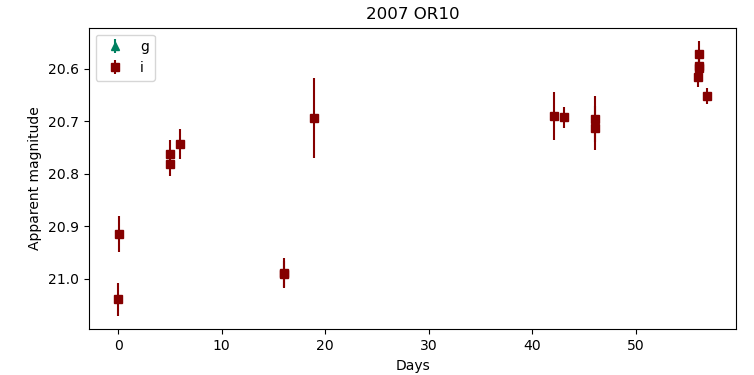
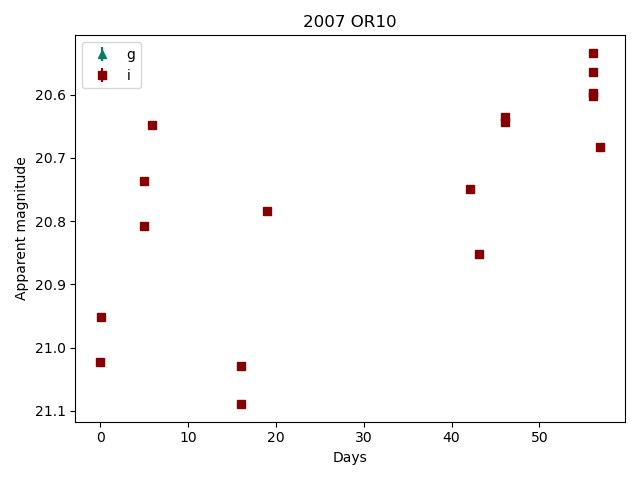
For 2007 OR10 which is moving ~1 arcsecond/hr and therefore definitely not trailed in Rubin data, I get different plots if I use the trailFlux versus the psfFlux. The error bars aren’t even close. I know this object is a point source because we know it’s orbit well so we know how fast it is going and I’ve observed it.
So how do I know when to use trailFlux? If something’s extended a pixel or 2 will that show up as a significant extendedness parameter value? Why are the error bars not consistent between the PSF Flux and Trail Flux.
PSF Flux
obj='2007 OR10'
 cmd = f"select dia.midpointMjdTai,scisql_nanojanskyToAbMag(dia.psfFlux) AS mag, scisql_nanojanskyToAbMagSigma(dia.psfFlux, dia.psfFluxErr) as rmsmag  from dp2.SSSource as sss INNER JOIN  dp2.DiaSource as dia on dia.diaSourceId = sss.diaSourceId where sss.designation='{obj}' and dia.pixelFlags_bad = 'False' and dia.isDipole = 0  and dia.psfFlux_flag = 0  and dia.pixelFlags_bad = 0  and dia.band='i'"
Trail Flux
obj='2007 OR10'
 cmd = f"select dia.midpointMjdTai,scisql_nanojanskyToAbMag(dia.trailFlux) AS mag, scisql_nanojanskyToAbMagSigma(dia.trailFlux, dia.trailFluxErr) as rmsmag  from dp2.SSSource as sss INNER JOIN  dp2.DiaSource as dia on dia.diaSourceId = sss.diaSourceId where sss.designation='{obj}' and dia.pixelFlags_bad = 'False' and dia.isDipole = 0  and dia.psfFlux_flag = 0  and dia.pixelFlags_bad = 0  and dia.band='i'"
obj='2007 OR10'
cmd = f"select dia.midpointMjdTai, dia.trailFlux, dia.trailFluxErr, dia.psfFlux, dia.psfFluxErr, dia.extendedness from dp2.SSSource as sss INNER JOIN  dp2.DiaSource as dia on dia.diaSourceId = sss.diaSourceId where sss.designation='{obj}' and dia.pixelFlags_bad = 'False' and dia.isDipole = 0  and dia.psfFlux_flag = 0  and dia.pixelFlags_bad = 0  and dia.band='i'"
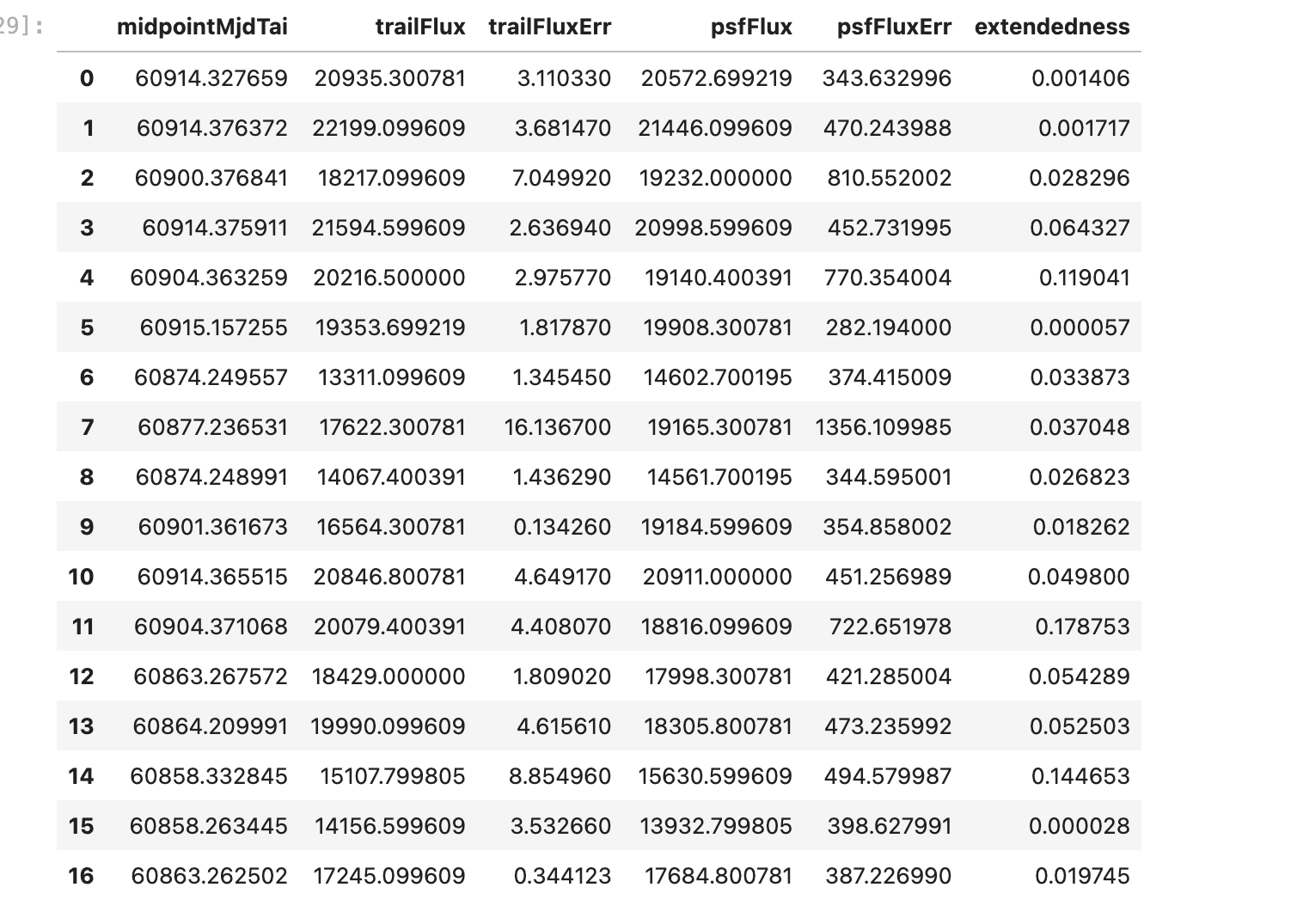
Clearly the error bars in the trail flux measurements are way off for 2007 OR10, but I would have thought that the trail Flux would be the same as the PSF Flux if the source isn’t extended, but how do I tell for a main belt asteroid which flux to use? When is the extendedness value producing accurate photometry?