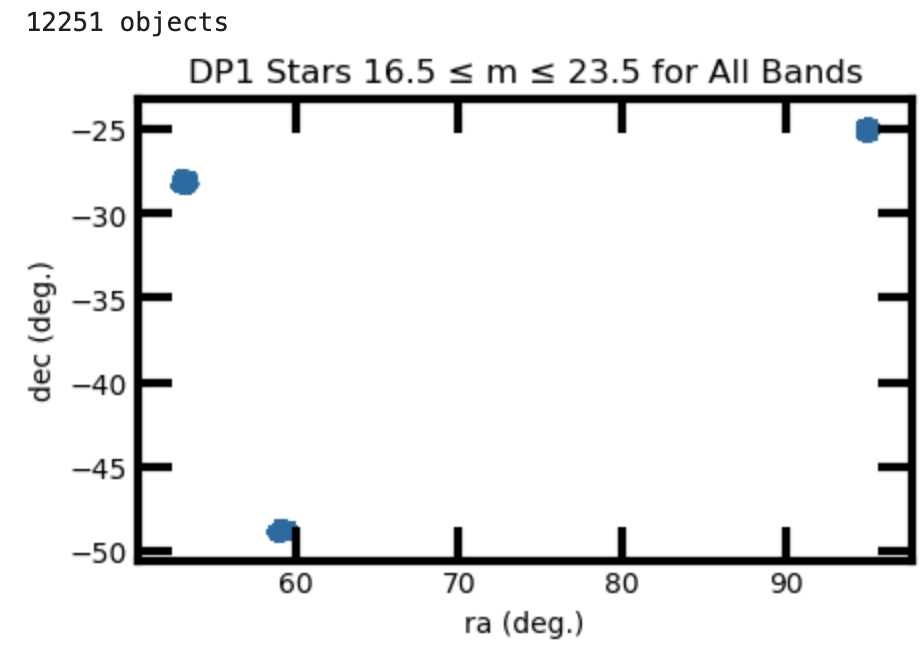
Hi! I tap_serviced this query from the dp1 object table:
query = “”"
SELECT coord_ra, coord_dec, objectId, u_psfMag, g_psfMag, r_psfMag, i_psfMag, z_psfMag, ebv,
u_psfMagErr, g_psfMagErr, r_psfMagErr, i_psfMagErr, z_psfMagErr,
refExtendedness
FROM dp1.Object
WHERE refExtendedness = 0
AND u_psfMag >= 16.5
AND u_psfMag <= 23.5
AND g_psfMag >= 16.5
AND g_psfMag <= 23.5
AND r_psfMag >= 16.5
AND r_psfMag <= 23.5
AND i_psfMag >= 16.5
AND i_psfMag <= 23.5
AND z_psfMag >= 16.5
AND z_psfMag <= 23.5
“”"
I got back over 12,000 hits, but when I looked at their positions, I only see three of the dp1 fields:
Hi Bob – that would be because of the query’s requirement on all of the ugriz bands (via the 16.5 < mag < 23.5 contraints). If you look at the table of how many observations were obtained in each filter, you’ll see that 3 fields had no u-band, and one field (Seagull Nebula) had u-band but no i-band observations. Thus those fields don’t have any stars meeting your criteria for those bands.
Hi @babel, I was just going to chime in with the same response that @jeffcarlin just beat me to. If you relax the requirement in your query to fewer bands with the specified magnitude ranges, you’ll see stars in more fields pop up. I’ll mark Jeff’s response as the solution.