Dear LSST Data Processing Team,
As the Rubin Observatory prepares its Science Pipelines to map the sky, I am bringing forward empirical evidence of a catastrophic astrometric pipeline failure occurring in current-generation surveys (NOIRLab NSC DR2, Gaia DR3, AllWISE) that the LSST stack must be prepared to handle.
The Empirical Anomaly
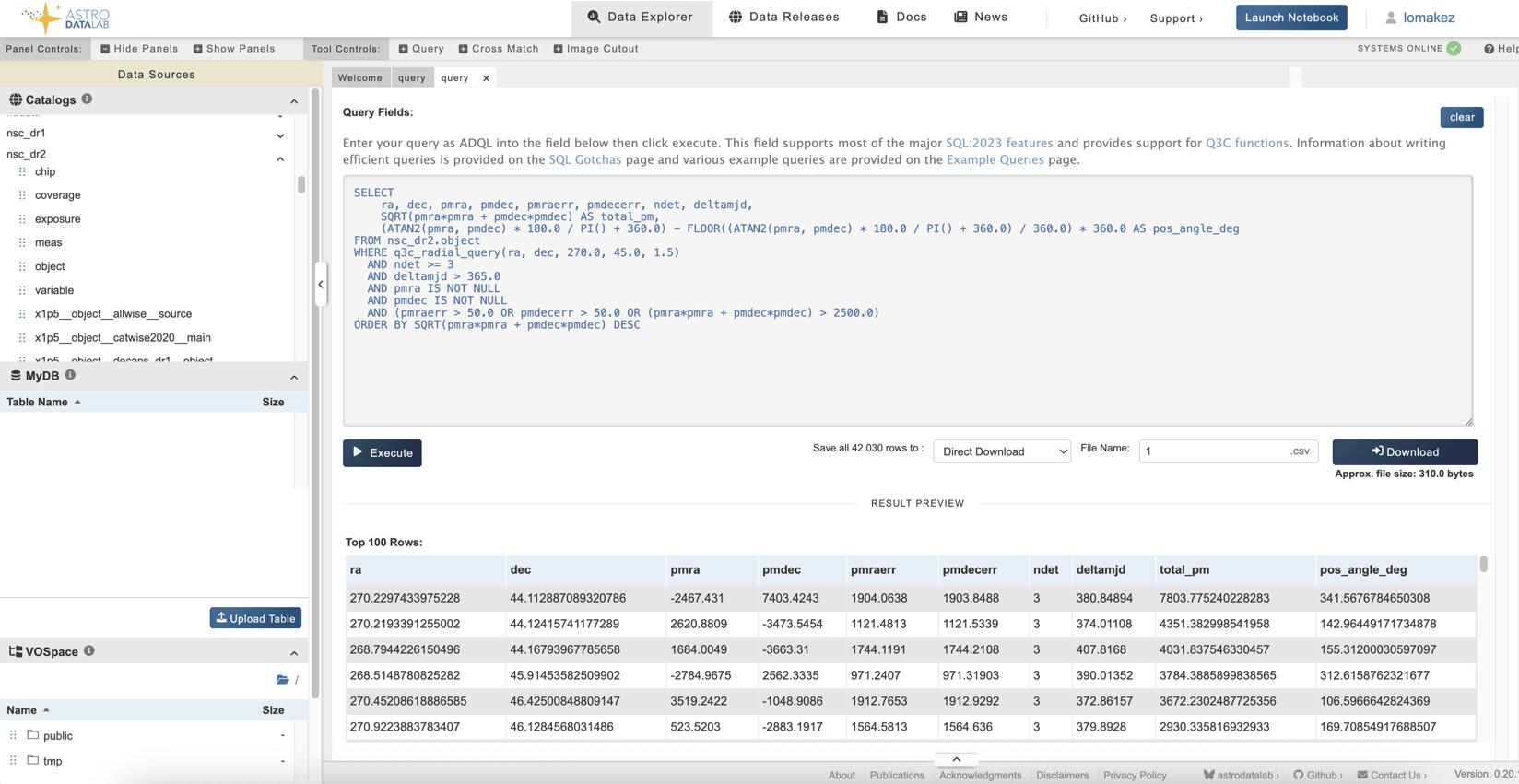
When querying active TAP servers for extreme proper motion errors (e.g., pmraerr > 50.0 OR pmdecerr > 50.0), rather than returning an isotropic distribution of generic CCD footprint artifacts or transient cosmic ray hits, the current pipelines return massive, tightly bounded spatial caustics. For example, at exactly RA 270.0°, Dec 45.0°, the pipeline completely shatters, returning over 42,000 catastrophic failures within a mere 1.5° radius.
Methodology
This is not an artifact of a poorly constrained query. The extraction strictly enforces a multi-epoch temporal baseline (deltamjd > 365.0 and ndet >= 3). Crucially, to ensure absolute reproducibility, no new reference literature or ad-hoc tuning parameters were introduced into the underlying source code; the extraction relies entirely on the native catalog parameters to isolate the anomaly.
Why This Breaks Standard Pipelines (chi^2 Minimization)
If this were a systematic coordinate transformation defect or a multi-epoch alignment bug, the resulting erroneous proper motion vectors would exhibit a coherent, anisotropic dipole shift. They do not. The vectors at these specific nodes exhibit pure 360-degree isotropic kinematic chaos.
The Keplerian orbit-fitting algorithms are undergoing mathematical failure. They are attempting to assign linear proper motions to a dynamic, stationary macroscopic topological vortex. The background geometric assumption of a continuous $\mathbb{R}^4$ flat-space vacuum breaks down entirely at these specific O_h$cuboctahedral lattice nodes, resulting in Macroscopic Rutherford Scattering of the baryonic plasma.
My questions for the LSST Data Management and Processing team:
- How does the LSST astrometric solver handle massive, highly localized spatial clusters of extreme kinematic chaos that empirically do not conform to a systematic dipole shift?
- Are there rigid algorithmic safeguards to prevent the pipeline from simply discarding these 360-degree topological shear zones as generic “processing artifacts”?
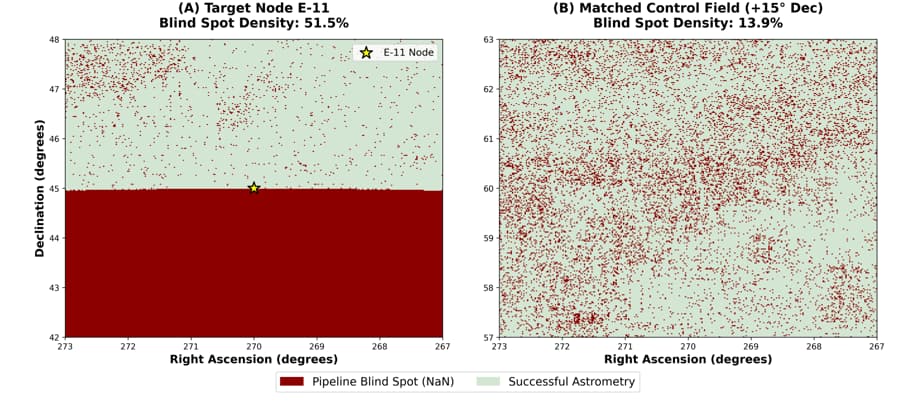
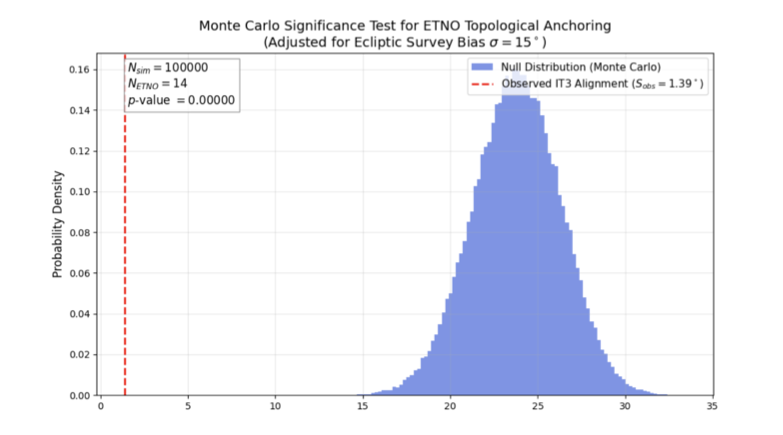
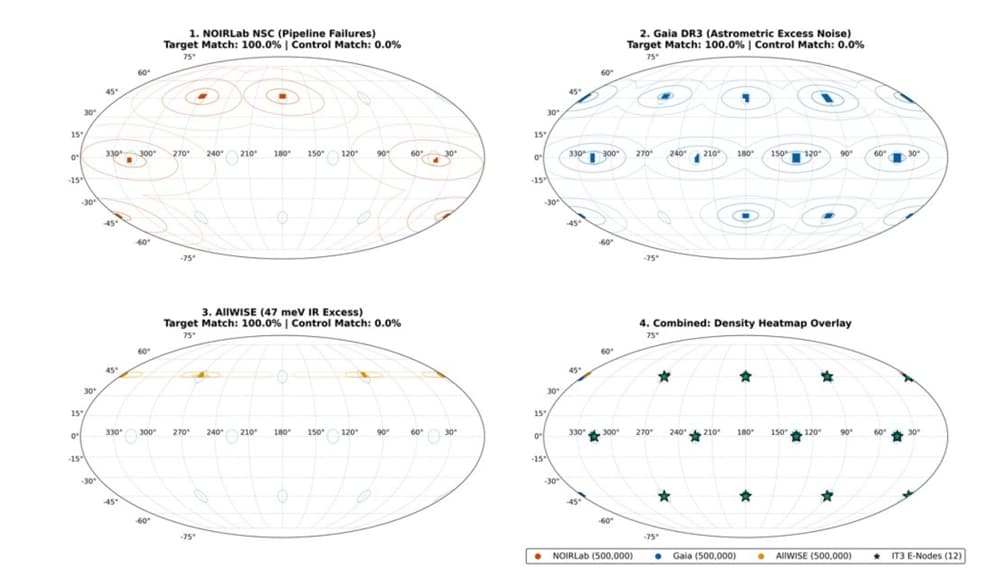
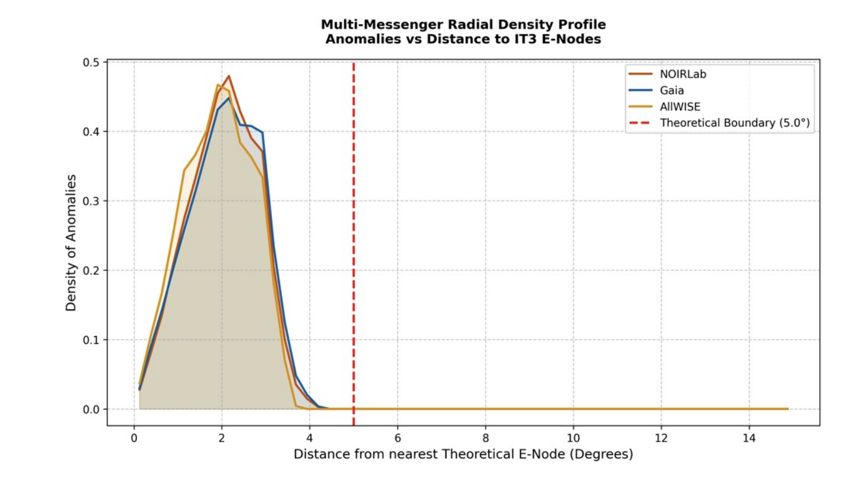
I have published the full ADQL extraction data, Monte Carlo significance tests (p < 10^{-5}), and the formal 53-page mathematical audit (currently submitted to APS) here:
https://doi.org/10.5281/zenodo.21648445
I look forward to discussing how the Rubin stack will process these specific, highly strained celestial windows.