Dear Colleagues,
We are writing to provide you with the promised update on Rubin’s performance and the path towards the start of the LSST. We are happy to report good progress in the past few weeks, both in understanding the system better and improving the image quality. Part of the good news is that we have moved significantly closer to the start of the LSST. In the latter half of March and April the Rubin Observatory team has emphasized on-sky engineering tests. A significant number of nights were dedicated to LSST-like observations in the second half of April and those observations have produced more alerts in that time than were produced in the second half of March…
While the team has been busy on sky, We have been working with Rubin leadership and our Management Board to develop an objective path to the start of the LSST in the months ahead. This path builds on recent technical progress by identifying the remaining challenges we face and outlining a strategic action plan to address them. This strategic plan includes tests, analysis, outcomes, and deployments for continuous improvements to image quality, reliability, and survey speed.
Rubin is now collecting data fit for a wide range of science. The path forward includes getting science images into your hands as soon as possible. Data Preview 2 (DP2) is on schedule for delivery in the July-September timeframe. Template fields from DP2 will soon be available on sky and result in a growing volume of alerts. Around the time DP2 is delivered, we will also start making nightly visit images and associated source catalogs available.
Finally, the plan we are developing includes a projection for how we expect the image quality and survey speed to continue to improve during Year 1, so that we can communicate to you what to expect in DR1, the Year 2 alert stream, and beyond. We are committed to delivering on the full science aspirations of the community for the complete LSST.
The plots below illustrate our recent progress. In these we compare the summit system performance from the end of construction last year (SV) to the current early operations period.
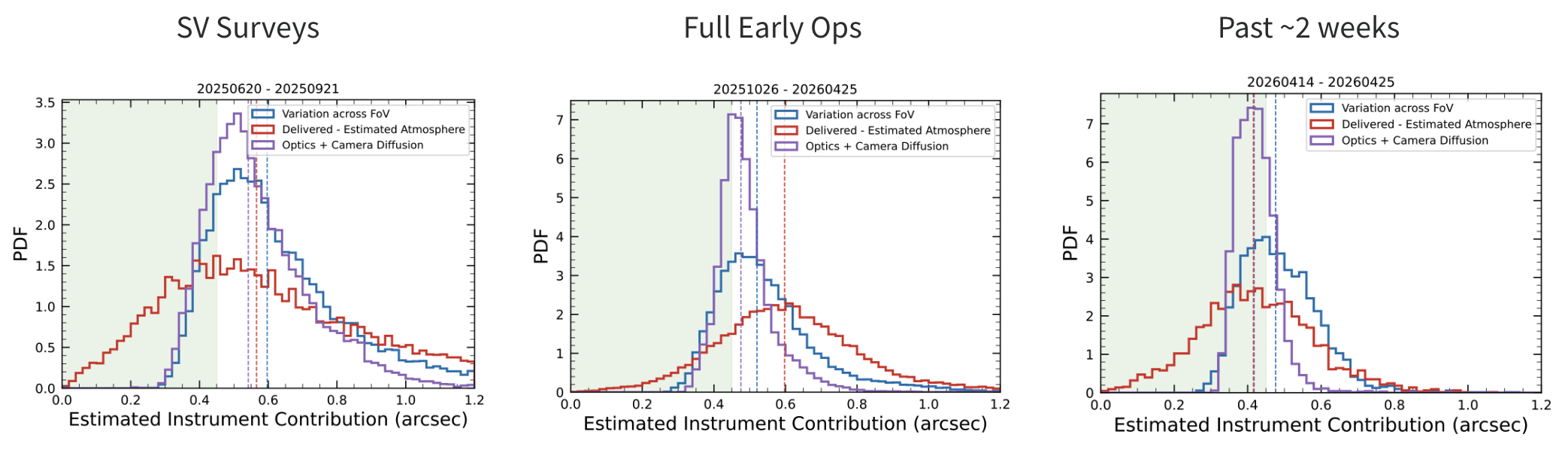
Distributions of three different estimates for the instrument contribution to the delivered image quality (iDIQ), including contributions from the telescope optics and LSSTCam, during different time periods. Left: the science validation phase of Construction Center: LSST-like observations during the full Early Operations period to date. Right: recent LSST-like observations from Early Operations. Medians are marked by the dotted lines. The green shaded area shows the target survey performance. These graphs show steady improvement in the imaging performance of the system – both in terms of image size and uniformity across the field. Only a small tail of the instrumental image contributions are outside the target performance region and the uniformity across the field is greatly improved in this recent, if limited sample.
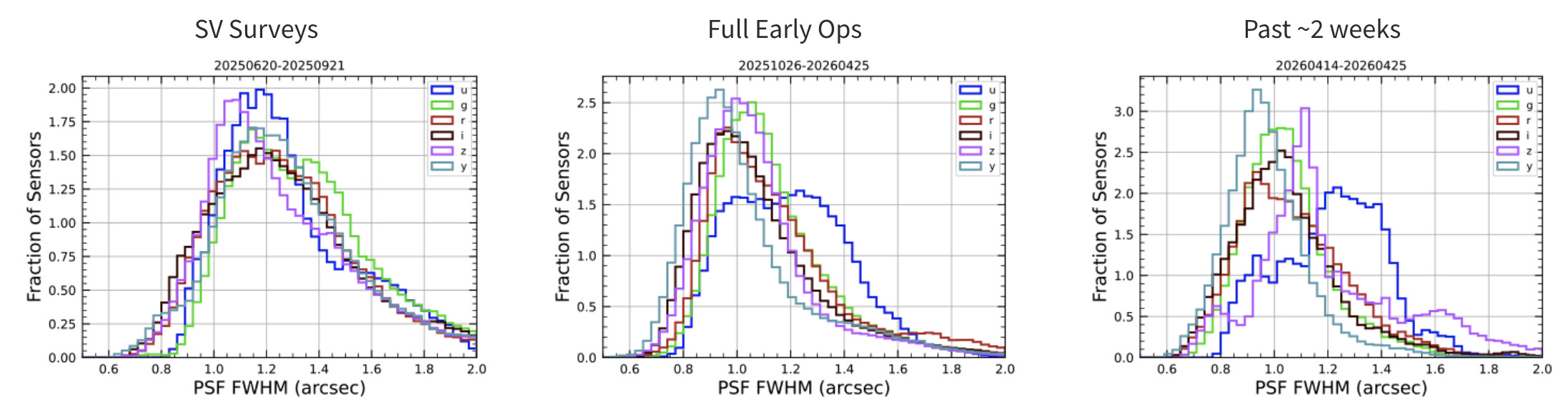
Distributions of the full delivered image quality, including the atmosphere and dome environment as well as the above instrument contribution. The median delivered image quality in the SV period (representative of DP2) is about 1.2’’ and for the current Early Operations period is about 1". The izy bands are yielding the best median image quality, which is now sub-arcsecond. Beyond improving the instrument contribution, we expect to further reduce the median iDIQ during Year 1 by steadily increasing the ventilation of the dome.
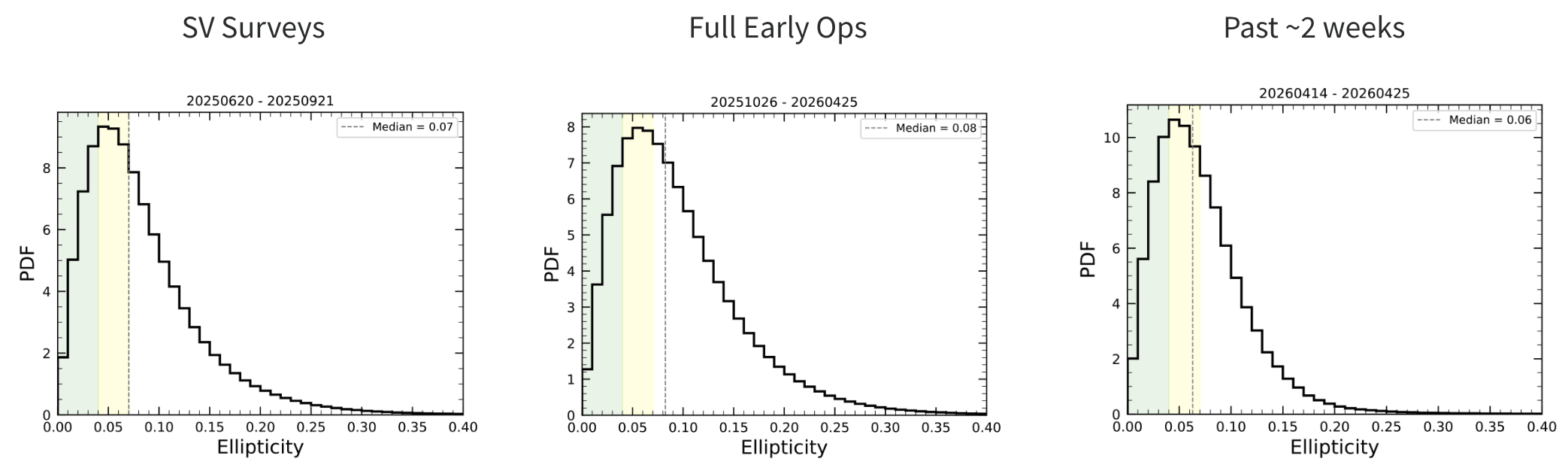
The PSF ellipticity distributions for each time period. Ellipticity typically improves with worse FWHM. The patterns we see in most of the stellar images across the focal plane are consistent with the ellipticity being due to the optics, rather than the atmosphere, dome environment, or Camera sensors. We expect the median PSF ellipticity to decrease as the active optics correction of the primary and secondary mirrors improves during Year 1.
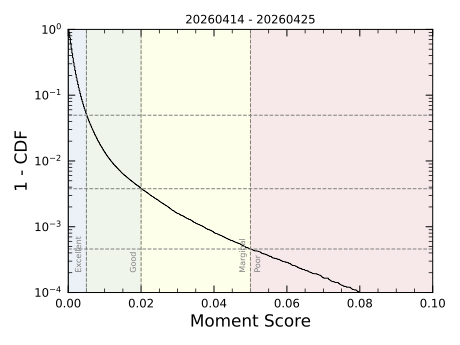
The degree to which the delivered PSF has structure beyond simple ellipticity can be captured via the power in the higher order moments(e.g., combinations of third and fourth order moments such as coma and trefoil aberrations). The complementary cumulative distribution function of “moment score” shown here for recent LSST-like observations shows that the majority of images are well described by their second moments. A low moment score indicates a well-behaved PSF that can be accurately described by an elliptical Gaussian. Larger scores represent more non-Gaussian power in the distribution of pixels making up the stellar PSFs; this can arise from small aberrations remaining after active optics correction of the mirror figures. The distribution above shows that the active optics correction has been working reasonably well most of the time: the vast majority of data we are taking have well-behaved PSFs and are thus appropriate for most science cases. Small PSFs can still have irregular shapes. Addressing such non-symmetric shapes is one of the issues we are working on.